from wiki
- Unlike other forms of capital, humans can choose their level of effort.
- It is costly for firms to determine how much effort workers are exerting.
A full description of this model can be found at the
links provided.
[34] Some key implications of this model are:
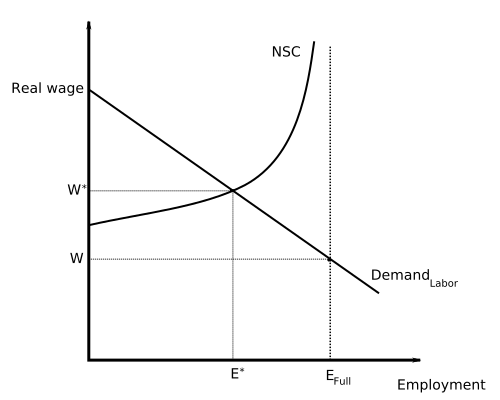
- Wages do not fall enough during recessions to prevent unemployment from rising. If the demand for labour falls, this lowers wages. But because wages have fallen, the probability of 'shirking' (workers not exerting effort) has risen. If employment levels are to be maintained, through a sufficient lowering of wages, workers will be less productive than before through the shirking effect. As a consequence, in the model wages do not fall enough to maintain employment levels at the previous state, because firms want to avoid excessive shirking by their workers. So, unemployment must rise during recessions, because wages are kept 'too high'.
- Possible corollary: Wage sluggishness. Moving from one private cost of hiring <w∗> to another private cost of hiring <w∗∗> will require each firm to repeatedly re-optimize wages in response to shifting unemployment rate. Firms cannot cut wages until unemployment rises sufficiently (a coordination problem).
The outcome is never Pareto efficient.
- Each firm employs too few workers because it faces private cost of hiring rather than the social cost — which is equal to and in all cases. This means that firms do not "internalize" the "external" cost of unemployment - they do not factor how large-scale unemployment harms society when assessing their own costs. This leads to a negative externality as marginal social cost exceeds the firm's marginal cost (MSC = Firm's Private Marginal Cost + Marginal External Cost of increased social unemployment)[clarification needed]
- There are also negative externalities. Each firm increases the asset value of unemployment <Vu> for all other firms by hiring.[clarification needed] But the first problem clearly dominates since the 'natural rate of unemployment' is always too high.



No comments:
Post a Comment