
Wednesday, February 27, 2013
great job benny
average UE during chair time:
Paul Volcker, 7.7%
Ben S. Bernanke, 7.3%
Arthur Burns, 6.3%
G. William Miller, 5.9%
Alan Greenspan, 5.5%
Thomas McCabe, 5.0%
William McC. Martin, 4.6%

Tuesday, February 26, 2013
When we get back to full employment......we won't fucking stay there....
That express annoys my left nut no end
When we get back ...as if it's like an occasional bad trip away from the usual we're in
No it's part of capitalism's Ixion's wheel
We turn and we turn
It's a cycle
Follows group features
1) employment up wage share down
2) employment down wage share up
3) employment down wage share down
4) employment down wage share down
The secondary secular misery ?
How bigs the loop ?
Where's the foci ?
Friday, February 22, 2013
shirk the work of a jerk
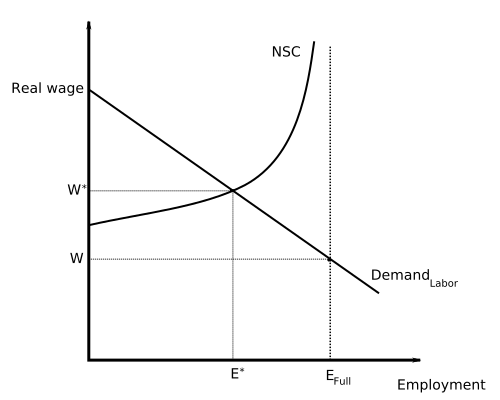
from wiki

- Unlike other forms of capital, humans can choose their level of effort.
- It is costly for firms to determine how much effort workers are exerting.
- Wages do not fall enough during recessions to prevent unemployment from rising. If the demand for labour falls, this lowers wages. But because wages have fallen, the probability of 'shirking' (workers not exerting effort) has risen. If employment levels are to be maintained, through a sufficient lowering of wages, workers will be less productive than before through the shirking effect. As a consequence, in the model wages do not fall enough to maintain employment levels at the previous state, because firms want to avoid excessive shirking by their workers. So, unemployment must rise during recessions, because wages are kept 'too high'.
- Possible corollary: Wage sluggishness. Moving from one private cost of hiring <w∗> to another private cost of hiring <w∗∗> will require each firm to repeatedly re-optimize wages in response to shifting unemployment rate. Firms cannot cut wages until unemployment rises sufficiently (a coordination problem).
- Each firm employs too few workers because it faces private cost of hiring rather than the social cost — which is equal to and in all cases. This means that firms do not "internalize" the "external" cost of unemployment - they do not factor how large-scale unemployment harms society when assessing their own costs. This leads to a negative externality as marginal social cost exceeds the firm's marginal cost (MSC = Firm's Private Marginal Cost + Marginal External Cost of increased social unemployment)[clarification needed]
- There are also negative externalities. Each firm increases the asset value of unemployment <Vu> for all other firms by hiring.[clarification needed] But the first problem clearly dominates since the 'natural rate of unemployment' is always too high.
Thursday, February 21, 2013
Tuesday, February 19, 2013
"It may be asked where the public will get the money to lend to the government if they do not curtail their investment and consumption. To understand this process it is best, I think, to imagine for a moment that the government pays its suppliers in government securities. The suppliers will, in general, not retain these securities but put them into circulation while buying other goods and services, and so on, until finally these securities will reach persons or firms which retain them as interest-yielding assets"
Monetary Economics, Wynne Godley and Marc Lavoie say this in a footnote:
Note that neo-classical economists don’t even get close to this equation, for otherwise, through equation (2.4), they would have been able to rediscover Kalecki’s (1971: 82–3) famous equation which says that profits are the sum of capitalist investment, capitalist consumption expenditures and government deficit, minus workers’ saving. Rewriting equation (2.3), we obtain:
FU = If + DEF − SAVh
which says that the retained earnings of firms are equal to the investment of firms plus the government deficit minus household saving. Thus, in contrast to neo-liberal thinking, the above equation implies that the larger the government deficit, the larger the retained earnings of firms; also the larger the saving of households, the smaller the retained earnings of firms, provided the left-out terms are kept constant. Of course the given equation also features the well-known relationship between investment and profits, whereby actual investment expenditures determine the realized level of retained earnings.
Tuesday, February 12, 2013


update on comparative job market recovery
"Getting the economy to 5 percent unemployment within two years — a return to the rate that prevailed when the recession began — would require job growth of closer to 284,984 a month."

Monday, February 4, 2013
small proprietors micro exploiters ?
maybe
but i can imagine the earned income subsidy reaching lots of un-incorporated self employeds
but i can imagine the earned income subsidy reaching lots of un-incorporated self employeds
guest post by brit bleeder with comment by owen paine
"How should we think about trade-offs in economic policy? Some tweets by Jon Stone have raised this question.
To see the issue, take the Resolution Foundation's estimate (pdf) of the effect of fully implementing a living wage. It reckons such a policy would raise the gross earnings of around five million workers by a total of £6.5bn, though some £2.9bn of this would be clawed back by the government in the form of higher taxes and lower tax credits and benefits.However, the higher wages would cost 160,000 jobs.
For the sake of argument, let's assume these numbers are roughly right. Is the cost of 160,000 jobs a good trade for higher net incomes for millions?
In terms of workers' raw income, the answer's yes: the £3.6bn rise for those who keep their jobs outweighs the income lost by those losing their jobs.
Measured by well-being, however, it's a closer call. Wellbeing increases only weakly with income, but falls sharply with job loss. This means that we need lots of winners from a living wage to offset the unemployment of a few.
We can roughly quantify this. A paper by Nattavudh Powdthavee suggests that, in terms of wellbeing, we need a 30% rise in income to offset being unemployed. This means that if the average winner from a living wage gains 3%, we need at least 10 winners for every unemployed*.
You might think this condition is fulfilled. It is, if we consider only the wellbeing of those earning less than the living wage. But their higher wages come at the expense of profits. How much you're troubled by this depends on how you regard those employers. Are they exploitative tax-fiddling mega corporations, or are they small businesses struggling to get by?
And then there's the standard question about utilitarianism: is it legitimate to impose (largeish) costs upon a minority so that the majority enjoy other benefits?
These concerns explain why many supporters of a living wage don't think it is something that should be mandated by legislation, but rather campaigned for on a workplace-by-workplace basis.This, though, runs into the problem that unions - the intelligent, non-statist way of improving workers' living standards - just don't have the bargaining power to do this.
There is, however, a way to improve workers' bargaining power - to have a (high) basic income which gives workers a decent outside option and thus greater ability to reject exploitative working conditions.
Which raises the question: why is the campaign for a living wage so much more popular than that for a basic income? I suspect the answer has less to do with technocratic or high-brow ethical considerations than an appeal to reciprocity: the living wage demands that hard workers get a "fair" deal. But I wonder whether such appeals - powerful as they are - are a sufficient basis for policy"
.
"* 3% might seem small. But remember that many people earn only a few pennies less than the living wage (which is one reason why it would destroy so few jobs), and others are second earners in quite well-off families. I say "at least" because this calcuation ignores the income loss of the unemployed themselves."
------------------------------------------
loss of 160k jobs ?
did we start at full employment ?
what happens if macronautic policy is
perpetual full employment ?
are we to believe the results of fiscal activism here
would be simply a change in the CPI rendering the living wage a hollow raise
with the job force bottom layer
right back to square one ...or worse ?
----------------------------
ever heard of an earned income credit system
the either or earned thru wage min or direct pay out by state
misses the wage subsidy system
-------------------------------------------------
then why raise the wage min ?
this spurs automation ?
the system adjustment to a higher then spontaneously emergent
but always wildly uneven lower wage rate surface *
might blot up some rent pools not reached by the tax
used to fund the wage subsidy
*lower wage surface versus statutory "floor"
location specific maybe even firm specific undulatory affair
job one may be lifting the entire wage rate structure
but job two is equalizing peer
shadow value added wage rates
------------------------------------------
loss of 160k jobs ?
did we start at full employment ?
what happens if macronautic policy is
perpetual full employment ?
are we to believe the results of fiscal activism here
would be simply a change in the CPI rendering the living wage a hollow raise
with the job force bottom layer
right back to square one ...or worse ?
----------------------------
ever heard of an earned income credit system
the either or earned thru wage min or direct pay out by state
misses the wage subsidy system
-------------------------------------------------
then why raise the wage min ?
this spurs automation ?
the system adjustment to a higher then spontaneously emergent
but always wildly uneven lower wage rate surface *
might blot up some rent pools not reached by the tax
used to fund the wage subsidy
*lower wage surface versus statutory "floor"
location specific maybe even firm specific undulatory affair
job one may be lifting the entire wage rate structure
but job two is equalizing peer
shadow value added wage rates
Subscribe to:
Comments (Atom)